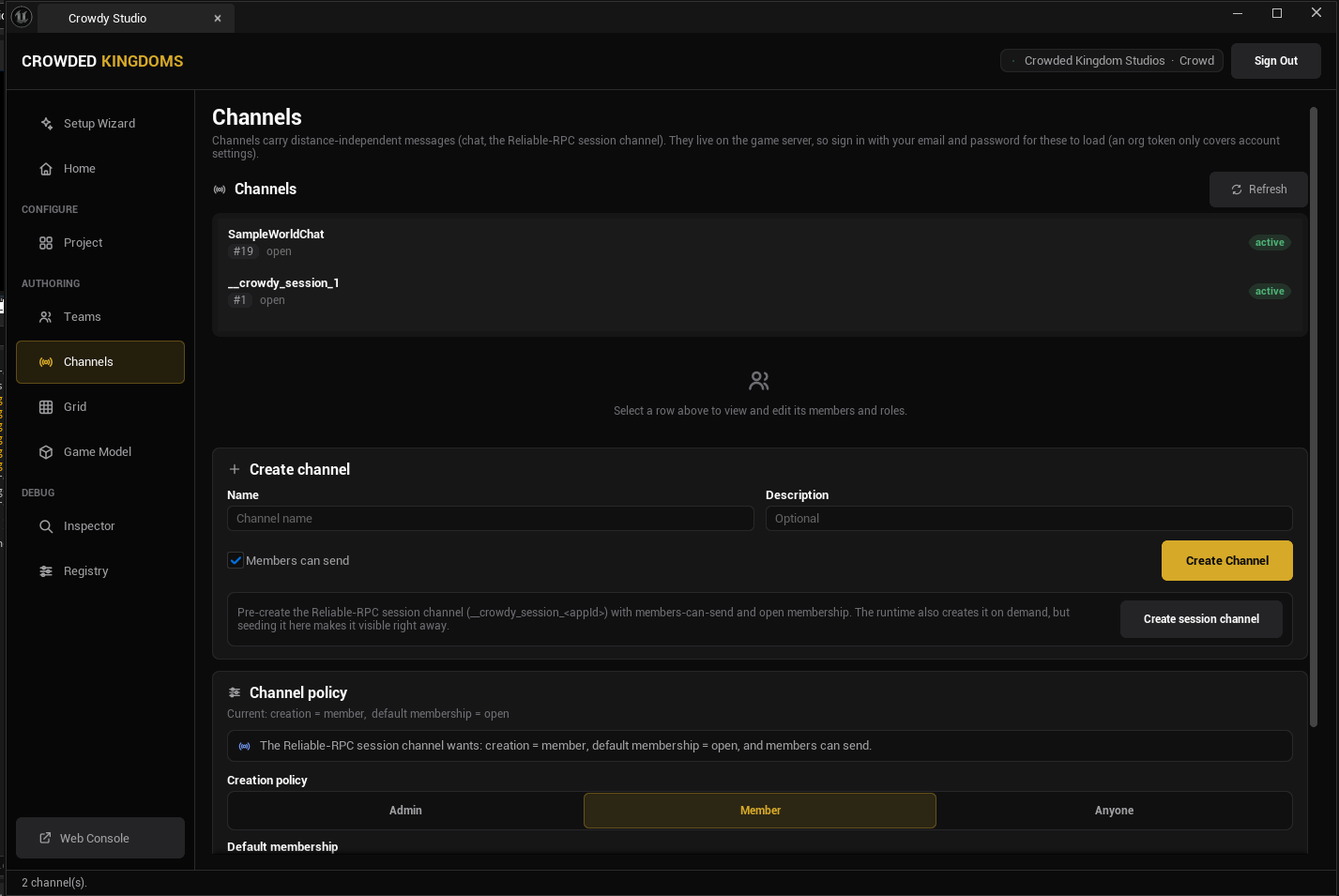
Channels
A channel is a named, non-spatial delivery group. Events and messages sent to a channel reach every member, at any distance, with no spatial decay.
This is the path you use for chat, lobby state, and other game-wide signals that are not tied to a position in the world.
There are two ways to use channels:
- Send a Multicast CrowdyEvent over a named channel. This rides the RPC system, so you get typed parameters and reliable delivery.
- Send a raw channel message with
PublishChannelMessage. This is a fire-and-forget byte broadcast with no delivery guarantees.
For how channels compare to the other recipient modes, see Recipients and routing.
The reliable channel is also what carries replicated subsystems: a host-owned subsystem's Crowdy State deltas and its Multicast CrowdyEvents both ride it rather than the spatial path. Note that a single channel message does not fragment, so it has a hard payload cap; keep any per-message content small.
Multicast events over a channel
A CrowdyEvent with the Multicast recipient routes over a named channel instead of through space. You name the channel with the CrowdyChannel meta on the receiver.
#include "Replication/RPC/CrowdyEvent.h"

UFUNCTION(meta=(CrowdyEvent, CrowdyRecipient="Multicast", CrowdyChannel="SampleWorldChat"))
void Announce_Implementation(const FString& Text, const TArray<int32>& Counts);
CROWDY_EVENT(Announce)
Call it like any other event:
Announce(TEXT("hello"), { 1, 2, 3 });
The event reaches every member of SampleWorldChat, regardless of where they are in the world.
CrowdyDecay and CrowdyDistance do not apply to a Multicast event. Those are spatial controls only.
Parameters work the same as any CrowdyEvent. You can pass typed values directly, with no payload struct. See Recipients and routing for the full list of allowed parameter types.
Auto-join on connect
You do not call a join function for these channels.
When the SDK opens its UDP connection it joins every channel referenced by a CrowdyChannel meta in your project, plus a default session channel.
The default session channel
Every connected client also joins a default channel named __crowdy_session_<appId>, where <appId> is your app's identifier.
A Multicast event with no CrowdyChannel set goes to this session channel, so a project-wide broadcast works without naming a channel.
The runtime channel set is the union of the default session channel and every CrowdyChannel name found across your receivers. Adding a new named channel is a matter of adding a receiver that references it; the join happens automatically on the next connect.
Raw channel messages
When you want to broadcast arbitrary bytes to channel members without the RPC layer, use UCrowdyChannels (module CrowdyServices).
TArray<uint8> Payload;
// fill Payload with your encoded bytes

Channels->PublishChannelMessage(ChannelId, Payload);
Receivers handle the broadcast through OnChannelMessageReceived. Bind a UFUNCTION to it and decode the payload yourself.
Membership has cache accessors and queries that follow the same pattern as Teams: read the cache for instant state, treat callbacks as eventual truth.
Raw messages versus RPC
Raw channel messages are fire-and-forget. They have no ordering and no receipt guarantee. A message can arrive out of order, or not arrive at all, and the sender is not told.
| Path | Typed params | Ordering | Delivery guarantee |
|---|---|---|---|
| Multicast CrowdyEvent | Yes | Yes | Reliable |
PublishChannelMessage | No (raw bytes) | No | None |
Use a Multicast CrowdyEvent when correctness matters: lobby state, score updates, anything a player would notice if it were dropped. Reach for PublishChannelMessage only for high-volume, lossy traffic where an occasional miss is acceptable and you are encoding your own bytes.
Creating and managing channels at runtime
You are not limited to authoring channels in Crowdy Studio. UCrowdyChannels (module CrowdyServices) lets your game create and manage them live.
- C++
- Blueprint
CreateChannel makes a new channel owned by the current player:
void CreateChannel(const FString& Name, const FString& Description,
                   ECrowdyTeamMembershipPolicy MembershipPolicy, bool bMembersCanSend,
                   FOnChannelSuccess OnSuccess, FOnChannelError OnError);
bMembersCanSend decides whether ordinary members may publish, or only send through roles you grant. The success delegate returns the new FCrowdyGroup with its GroupId.
The rest of the surface mirrors teams, with per-call success and error delegates:
- Channel lifecycle:
UpdateChannel,DeleteChannel. - Membership:
JoinChannel,RequestToJoinChannel,LeaveChannel,AddChannelMember,RemoveChannelMember. - Roles and policy:
CreateChannelRole,UpdateChannelRole,DeleteChannelRole,SetChannelMemberRoles,SetChannelPolicy. - Cache and queries:
GetCachedMyChannels,IsPlayerInChannel,HasPermissionInChannel,GetMyChannels, and theOnMyChannelsCacheChangeddelegate. These follow the same cache-first pattern as Teams.
All channel operations are available as Blueprint async action nodes under Crowdy SDK | Channels. They follow the same pattern as the Teams Blueprint nodes: each node has OnSuccess and OnError output pins you bind directly in the graph.
Query nodes (under Crowdy SDK | Channels | Queries):
| Node | OnSuccess pins |
|---|---|
| Get My Channels | Memberships (FCrowdyMyChannelsResult) |
| Get Channel | Channel (FCrowdyGroup) |
| Get All Channels | Channels (FCrowdyChannelsResult) |
| Get Channel Members | Members (FCrowdyChannelMembersResult) |
| Get Channel Roles | Roles (FCrowdyChannelRolesResult) |
| Get Channel Policy | Policy (FCrowdyAppGroupPolicy) |
| Get Pending Join Requests | Members (FCrowdyChannelMembersResult) |
Mutation nodes (under Crowdy SDK | Channels | Mutations):
Create Channel, Update Channel, Delete Channel, Join Channel, Request to Join Channel, Leave Channel, Add Channel Member, Remove Channel Member, Set Channel Member Roles, Create Channel Role, Update Channel Role, Delete Channel Role, Set Channel Policy.
Array result structs: operations that return a list wrap the array in a result struct
(FCrowdyChannelsResult, FCrowdyMyChannelsResult, FCrowdyChannelMembersResult,
FCrowdyChannelRolesResult). Break the struct in the graph to reach the inner array. This
is a Blueprint reflection requirement; the inner array type is the same FCrowdyGroup /
FCrowdyGroupMembership / FCrowdyGroupMember / FCrowdyGroupRole you would use in C++.
Whether a player may create or change a channel is decided by the server from your app's policy, so a rejected call returns through the error delegate.
Crowdy Studio offers the same operations as a native editor surface, which is convenient for setting channels up ahead of time. See the Studio Teams and Channels page.