Actor State
Actor state is how a Dynamic entity keeps its visual state replicated across clients without you sending anything by hand.
- The owner takes a snapshot of the actor about ten times a second.
- The SDK pushes that snapshot to every other client.
- Remote clients apply the snapshot through the rendering backend.
You drive this with a UActorUpdateExecutor. The executor answers two questions: what does a snapshot of this actor look like right now, and what struct type carries it on the wire.
This page covers the executor in both C++ and Blueprint, and how Dynamic mode differs from Static mode.
Dynamic mode versus Static mode
A UCrowdyEntityComponent runs in one of two modes, set by its Mode property.
- Dynamic mode polls a
StateExecutorfor continuous state. Use it for anything that moves, animates, or changes pose on its own: pawns, projectiles, moving props. Dynamic is the only mode that has aStateExecutorandbAutoRegister. - Static mode does no polling. A Static entity has identity and can still send and receive
CrowdyEventRPCs throughSendEvent, but it has no continuous snapshot. Use it for things that change only on discrete events: a switch, a door that opens once, a chat relay.
In short: Dynamic mode replicates a snapshot on a timer, then Static mode replicates only when you fire an event.
If you only need to replicate one or two individual properties, and would rather not author a snapshot struct and executor at all, Crowdy State is the lighter-weight sibling channel. You mark a UPROPERTY, and the owning client diffs and ships just that value. Actor State is the better fit when many fields move together as one coherent snapshot.
Both modes use the same CrowdyEvent RPC path for discrete events. The difference is only the continuous snapshot. See RPC events for events.
The executor
UActorUpdateExecutor is an abstract, Blueprintable UObject. You subclass it and override two functions.
GetActorState(const UActorComponent* UpdateComponent)returns anFInstancedStruct. This runs on the owner about ten times a second. Read the current state off the actor and return your snapshot struct.UpdateComponent->GetOwner()is the actor that owns the component.GetStateStruct()returns aUScriptStruct*. ReturnYourState::StaticStruct(). Declaring the type here is what registers it for the wire, so the same struct can be deserialized on remote clients.
You then assign an instance of your executor to the component's StateExecutor in the actor constructor.
Only the owner runs GetActorState. Remote clients hold a RemoteProxy of the entity that is fed from the network, and the owner gets no proxy of itself. Do not put owner-only logic in GetActorState; treat it as a read-only snapshot.
Snapshot struct
Define a plain USTRUCT that holds exactly the state you want to replicate.
Keep it small. It travels at roughly ten hertz, so only put what the remote view needs.
USTRUCT()
struct FMyEntityState
{
    GENERATED_BODY()

    UPROPERTY()
    FVector Location = FVector::ZeroVector;

    UPROPERTY()
    FRotator Rotation = FRotator::ZeroRotator;

    UPROPERTY()
    float Speed = 0.0f;
};
Write the executor
The executor reads the actor and hands back a snapshot. You can write it in C++ or in Blueprint; both behave the same. The owner runs Get Actor State at the profile's replication rate and remote clients apply the snapshot.
- C++
- Blueprint
Subclass UActorUpdateExecutor and override the two functions.
#include "Replication/Executor/ActorUpdateExecutor.h"
#include "StructUtils/InstancedStruct.h"
#include "MyEntityState.h"
#include "MyEntityExecutor.generated.h"

UCLASS()
class UMyEntityExecutor : public UActorUpdateExecutor
{
    GENERATED_BODY()

public:
    virtual FInstancedStruct GetActorState(const UActorComponent* UpdateComponent) override;
    virtual UScriptStruct* GetStateStruct() override;
};
#include "MyEntityExecutor.h"
#include "GameFramework/Actor.h"

FInstancedStruct UMyEntityExecutor::GetActorState(const UActorComponent* UpdateComponent)
{
    FMyEntityState State;

    if (const AActor* Actor = UpdateComponent->GetOwner())
    {
        State.Location = Actor->GetActorLocation();
        State.Rotation = Actor->GetActorRotation();
        State.Speed = Actor->GetVelocity().Size();
    }

    return FInstancedStruct::Make(State);
}

UScriptStruct* UMyEntityExecutor::GetStateStruct()
{
    return FMyEntityState::StaticStruct();
}
Create a Blueprint subclass of UActorUpdateExecutor and override the two functions.
- In the Content Browser, create a new Blueprint Class. For the parent class, search for and pick
ActorUpdateExecutor.
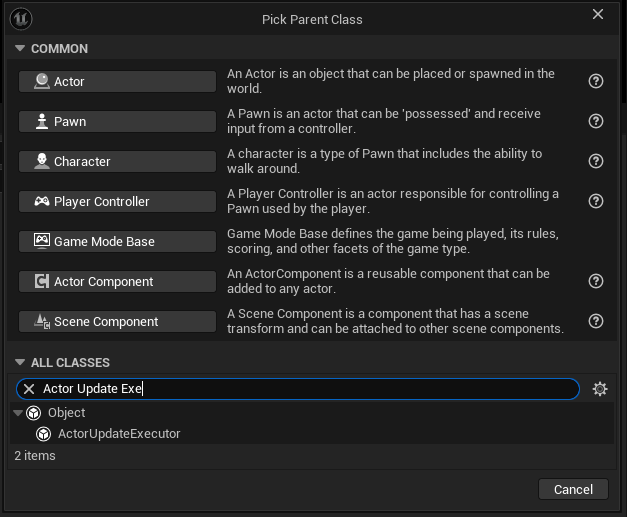
- Open the Blueprint. In My Blueprint, under Functions, find the two overridable functions and add them: Get Actor State and Get State Struct.
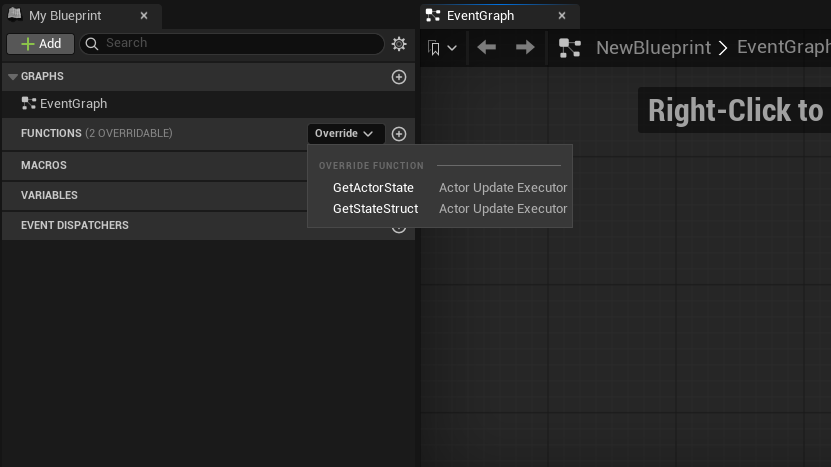
- In Get State Struct, return your state struct type. Drag off the return node and set it to your snapshot struct. This registers the type for the wire.
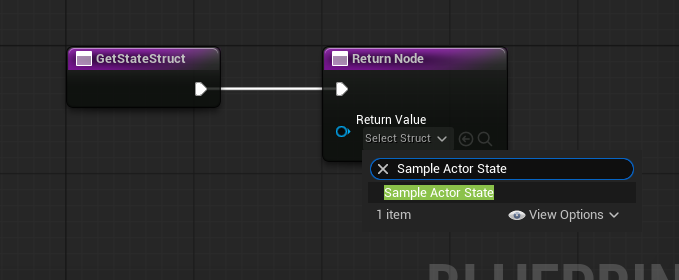
- In Get Actor State, read the values you want off the actor, fill a struct of your snapshot type, then wrap it with a Make InstancedStruct node and return it. Use the
UpdateComponentinput to reach the owning actor through Get Owner.
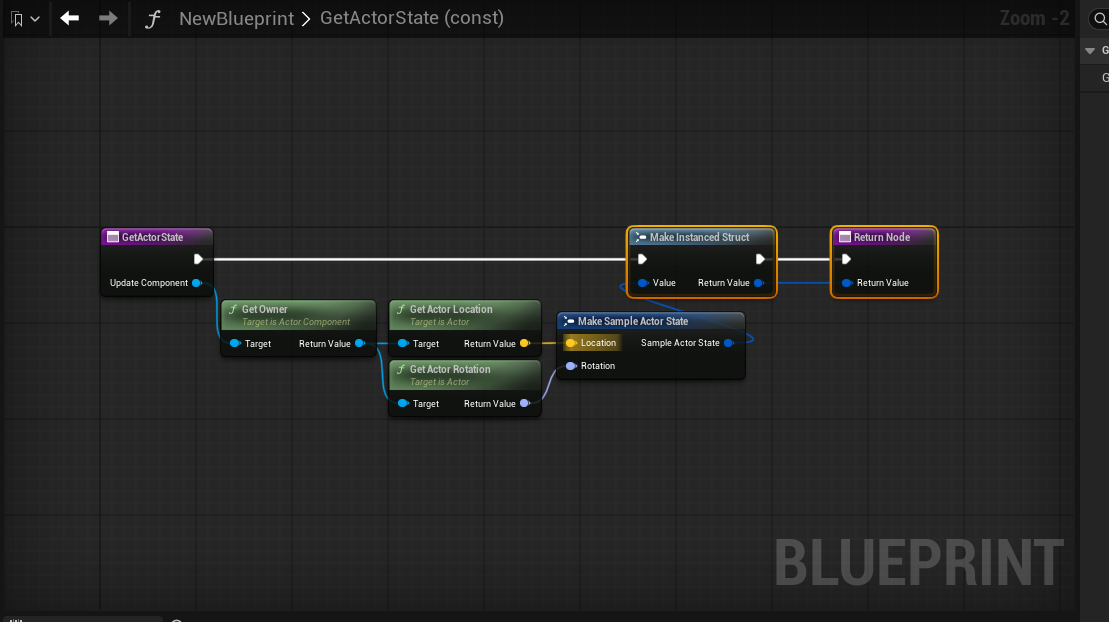
Wire the executor into the actor
Add a UCrowdyEntityComponent, set it to Dynamic, and assign your executor to StateExecutor.
- C++
- Blueprint
Create the executor as a default subobject in the actor constructor.
#include "GameFramework/Actor.h"
#include "Replication/Components/CrowdyEntityComponent.h"
#include "MyEntityExecutor.h"
#include "MyReplicatedActor.generated.h"

UCLASS()
class AMyReplicatedActor : public AActor
{
    GENERATED_BODY()

public:
    AMyReplicatedActor();

private:
    UPROPERTY(VisibleAnywhere)
    TObjectPtr<UCrowdyEntityComponent> CrowdyEntity;
};
#include "MyReplicatedActor.h"

AMyReplicatedActor::AMyReplicatedActor()
{
    PrimaryActorTick.bCanEverTick = true;

    CrowdyEntity = CreateDefaultSubobject<UCrowdyEntityComponent>(TEXT("CrowdyEntity"));
    CrowdyEntity->Mode = ECrowdyEntityMode::Dynamic;
    CrowdyEntity->StateExecutor = CreateDefaultSubobject<UMyEntityExecutor>(TEXT("Executor"));
}
Assign the Blueprint executor on your entity actor. Select the CrowdyEntityComponent, set Mode to Dynamic, and set the State Executor to your Blueprint executor class.
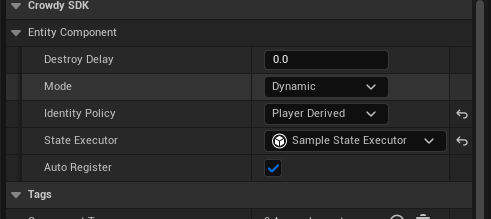
That is the whole setup. The owner simulates the actor however it likes; the executor snapshots it; remote clients receive the snapshot and render a proxy through the backend.
Polling rate
The auto replicator polls GetActorState about ten times a second, owner-only.
The exact rate is set per map by ReplicationIntervalHz on the map profile (1 to 10, default 10). See Map profiles for the profile setup.
If bUseAutoReplicator is off on the profile, or the map has no profile at all, no polling happens and replication looks dead.
Continuous state is for the realtime view plane: position, rotation, animation. It is client-authoritative and not enforced. Do not put cheat-sensitive or authoritative values, such as health or inventory, in the snapshot struct.