Entities and Spawning
An entity is an actor that the SDK tracks and replicates across every client. You make an actor into an entity by adding a UCrowdyEntityComponent to it.
From there the component:
- Decides who owns the entity.
- Hands you spawn and destroy callbacks.
- Gives you the hooks for continuous state and RPC events.
This page covers:
- Adding the component in C++ or Blueprint.
- Choosing the entity's mode and identity.
- The owner versus remote proxy split.
- Spawning and destroying through the SDK.
- How a remote client rebuilds the entity from a spawn event.
Adding the entity component
Add the component in your actor constructor with CreateDefaultSubobject. That is enough to register the actor as an entity once it enters a networked world.
- C++
- Blueprint
#include "Replication/Components/CrowdyEntityComponent.h"

ACrowdyExampleActor::ACrowdyExampleActor()
{
    PrimaryActorTick.bCanEverTick = true;

    CrowdyEntity = CreateDefaultSubobject<UCrowdyEntityComponent>(TEXT("CrowdyEntity"));
    CrowdyEntity->Mode = ECrowdyEntityMode::Dynamic;
    CrowdyEntity->IdentityPolicy = ECrowdyIdentityPolicy::Random;
}
Open your actor Blueprint. In the Components panel, click Add and pick Crowdy Entity Component.
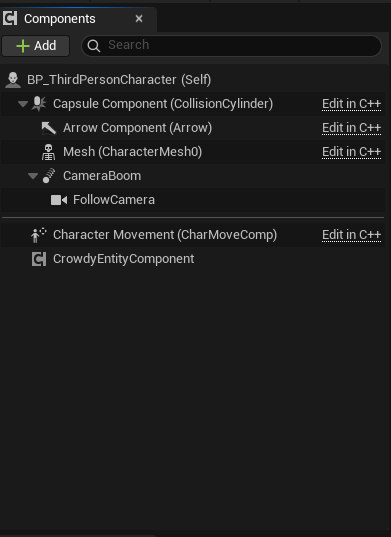
Select the component and open the Details panel. Set Mode (Dynamic or Static) and Identity Policy (Stable, Player Derived, or Random). For a Dynamic entity, assign a State Executor.
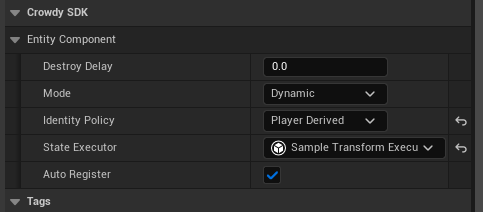
Mode
Mode is an ECrowdyEntityMode:
Dynamic: the entity sends continuous state through aUActorUpdateExecutorand is polled by the auto replicator. Use this for anything that moves or animates.Static: the entity exists and can send and receive RPC events, but it does not stream a state snapshot. Use this for fixed objects such as a world switch or a chat relay.
StateExecutor and bAutoRegister apply to Dynamic mode only. Actor Update Executor is covered on the Actor State page.
Identity policy
IdentityPolicy is an ECrowdyIdentityPolicy and decides how the entity's NetID is assigned:
Stable: a fixed identity that is the same across sessions. Use this for a placed level actor that should keep the same NetID every run.PlayerDerived: the identity is tied to the local player. Use this for a player pawn so the entity's NetID matches its owner.Random: a fresh identity each time the entity is created. Use this for spawned, throwaway objects.
Ownership and authority
By default an entity is owned by the client that spawns or places it (Ownership = Local Client, role Owner). These fields change that. Ownership and HostOverride take effect only on a self-resolving entity -- a level-placed actor, or one with IdentityPolicy = Stable. A runtime-spawned entity gets its role from the spawn event instead, so it ignores Ownership.
Ownership(ECrowdyOwnership, defaultLocal Client): set it to Host for a level-placed world or AI entity that should belong to whichever client is the elected host rather than to any one player. Its role becomesHostOwned. Such an entity almost always wantsIdentityPolicy = Stableso every client computes the same NetID; the component warns if you pick Host with any other policy.HostOverride(ECrowdyHostOverride, defaultAllow, shown only whenOwnership = Local Client): whether the elected host may correct this entity's Crowdy State as a super-user.Allowaccepts and adopts a host correction;Owner Onlydrops even a host correction, so only the owner ever writes it.StateHeartbeat(ECrowdyStateHeartbeat, defaultInherit):Offis a per-entity kill switch for the Crowdy State keyframe heartbeat. On-change replication is unaffected either way.bAutoApproveOwnershipRequests(default off): when set, this entity's current authority grants an incoming ownership-transfer request immediately instead of raisingOnOwnershipRequestedfor game code to decide.
Ownership is a separate axis from Mode and IdentityPolicy. For host precedence, world entities, and the request/grant transfer flow, see Host Authority and Crowdy State.
Owner, remote proxy, and IsLocallyOwned
Every entity has exactly one owner. The owner simulates the entity and sends its state and events.
Every other client holds a RemoteProxy: a copy that is fed from the network and never simulated locally. The owner does not get a proxy of itself.
GetRole() returns an ECrowdyRole:
None: no role assigned yet.Owner: this client owns and drives the entity.RemoteProxy: this client mirrors an entity owned elsewhere.HostOwned: the entity is owned by the elected host.
Use IsLocallyOwned() to branch between the side that drives the entity and the side that only displays it.
Run input, simulation, and gameplay logic only when IsLocallyOwned() is true.
void ACrowdyExampleActor::Tick(float DeltaSeconds)
{
    Super::Tick(DeltaSeconds);

    if (CrowdyEntity->IsLocallyOwned())
    {
        // Drive the entity here. The executor will snapshot the result.
    }
}
Other accessors on the component:
GetNetID()returns the entity's network identity.GetOwnerID()returns the identity of the owning client.GetMode()returns the configuredECrowdyEntityMode.GetOwnership(),GetHostOverridePolicy(), andGetStateHeartbeat()return the authority-config fields covered above.
The component also exposes MarkStateDirty(FName) and MarkAllStateDirty() for Crowdy State manual-dirty properties. Ownership transfer is driven through the static ownership-transfer nodes, not by calling the component directly.
Spawning an entity
Spawn entities through the SDK so every client creates the same actor with the same identity.
Do not spawn entities with the plain engine spawn path. Use the SDK spawn calls below so identity and the spawn event stay in sync across clients.
The spawn is deferred so the entity has its identity before BeginPlay. The SDK then broadcasts a spawn event so every other client spawns the same class. The InitialState you pass arrives in OnCrowdySpawned on every client, including the spawner.
- C++
- Blueprint
The Blueprint-friendly statics live on UCrowdyUtilities (module CrowdyServices):
#include "Utils/CrowdyUtilities.h"

FTransform SpawnTransform(FRotator::ZeroRotator, SpawnLocation);

FSampleSpawnInfo Info;
Info.Tint = FLinearColor::Red;
Info.DisplayName = TEXT("Block A");

FInstancedStruct InitialState = FInstancedStruct::Make(Info);

AActor* Spawned = UCrowdyUtilities::SpawnCrowdyEntity(
    this,
    ACrowdyExampleActor::StaticClass(),
    SpawnTransform,
    InitialState);
The same operation is available on the UCrowdyEntitySubsystem world subsystem (module CrowdyReplication) as SpawnEntity(TSubclassOf<AActor>, const FTransform&, const FInstancedStruct&).
To spawn from Blueprint, call Spawn Crowdy Entity with a class, a transform, and an initial state. This is the Blueprint-friendly static on UCrowdyUtilities.
Put any per-spawn data that remote clients need, such as a color or a display name, into the InitialState struct. That is the only payload that travels with the spawn event.
Receiving the spawn on a remote client
A remote client does not call your spawn code. Instead it:
- Receives the spawn event.
- Creates the actor.
- Fires
OnCrowdySpawnedon the new entity's component.
Bind that delegate to read the initial state and to set up owner versus proxy behavior.
- C++
- Blueprint
void ACrowdyExampleActor::BeginPlay()
{
    Super::BeginPlay();

    CrowdyEntity->OnCrowdySpawned.AddDynamic(this, &ACrowdyExampleActor::HandleCrowdySpawned);
    CrowdyEntity->OnCrowdyDestroyed.AddDynamic(this, &ACrowdyExampleActor::HandleCrowdyDestroyed);
}

void ACrowdyExampleActor::HandleCrowdySpawned(const FInstancedStruct& InitialState, bool bIsLocallyOwned)
{
    if (const FSampleSpawnInfo* Info = InitialState.GetPtr<FSampleSpawnInfo>())
    {
        ApplyTint(Info->Tint);
        SetDisplayName(Info->DisplayName);
    }

    if (!bIsLocallyOwned)
    {
        // This client holds a RemoteProxy. Disable local input and simulation.
    }
}
In the Event Graph, find the component under Variables and add the On Crowdy Spawned event. It gives you the Initial State as an instanced struct and an Is Locally Owned boolean.
- Break the initial state to read your spawn data.
- Branch on Is Locally Owned to split owner logic from proxy display.
- Add On Crowdy Destroyed the same way for teardown.
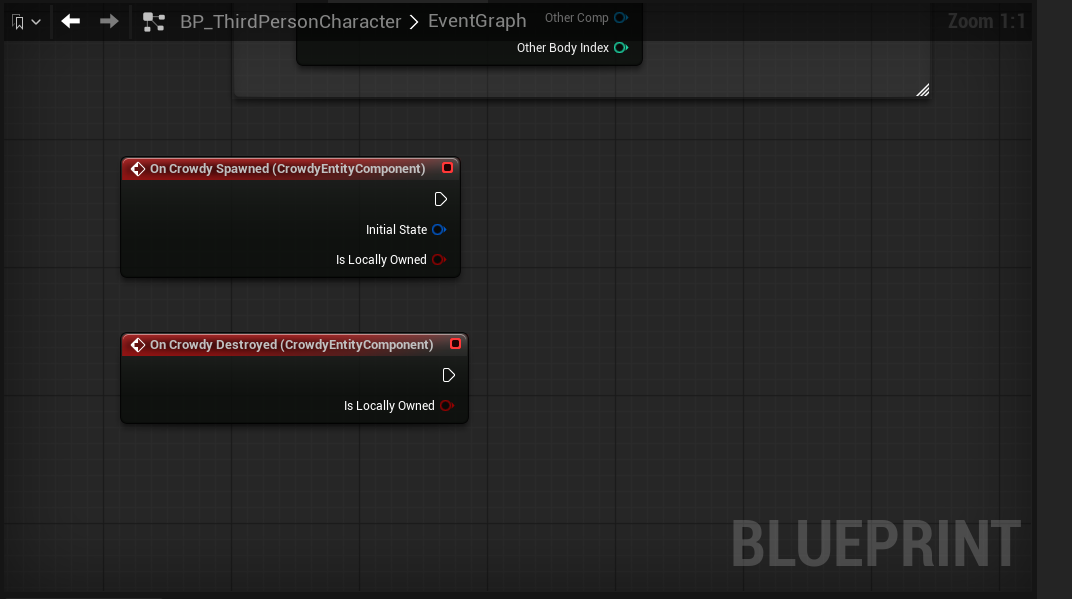
bIsLocallyOwned tells you which side you are on without a second call. The owner side gets true; every proxy gets false.
Destroying an entity
Destroy through the SDK so the destroy propagates to every client.
- C++
- Blueprint
Use the static:
UCrowdyUtilities::DestroyCrowdyEntity(this, Spawned);
Equivalents:
- The subsystem method is
DestroyEntity(AActor*). - You can also call
DestroyEntity()on the component itself. DestroyDelayon the component sets an optional delay before the actor is torn down.
To remove an entity, call Destroy Crowdy Entity. This is the Blueprint-friendly static on UCrowdyUtilities.
When the entity is removed, OnCrowdyDestroyed(bool bIsLocallyOwned) fires on every client so you can run teardown such as releasing effects or detaching widgets.
A complete C++ example actor
This actor is a Dynamic, randomly identified entity. It reads its spawn info on every client and runs gameplay only on the owner.
// CrowdyExampleActor.h
#pragma once

#include "CoreMinimal.h"
#include "GameFramework/Actor.h"
#include "StructUtils/InstancedStruct.h"
#include "Replication/Components/CrowdyEntityComponent.h"
#include "CrowdyExampleActor.generated.h"

UCLASS()
class ACrowdyExampleActor : public AActor
{
    GENERATED_BODY()

public:
    ACrowdyExampleActor();

    virtual void BeginPlay() override;
    virtual void Tick(float DeltaSeconds) override;

private:
    UFUNCTION()
    void HandleCrowdySpawned(const FInstancedStruct& InitialState, bool bIsLocallyOwned);

    UFUNCTION()
    void HandleCrowdyDestroyed(bool bIsLocallyOwned);

    UPROPERTY(VisibleAnywhere)
    TObjectPtr<UCrowdyEntityComponent> CrowdyEntity;
};
// CrowdyExampleActor.cpp
#include "CrowdyExampleActor.h"

ACrowdyExampleActor::ACrowdyExampleActor()
{
    PrimaryActorTick.bCanEverTick = true;

    CrowdyEntity = CreateDefaultSubobject<UCrowdyEntityComponent>(TEXT("CrowdyEntity"));
    CrowdyEntity->Mode = ECrowdyEntityMode::Dynamic;
    CrowdyEntity->IdentityPolicy = ECrowdyIdentityPolicy::Random;
}

void ACrowdyExampleActor::BeginPlay()
{
    Super::BeginPlay();

    CrowdyEntity->OnCrowdySpawned.AddDynamic(this, &ACrowdyExampleActor::HandleCrowdySpawned);
    CrowdyEntity->OnCrowdyDestroyed.AddDynamic(this, &ACrowdyExampleActor::HandleCrowdyDestroyed);
}

void ACrowdyExampleActor::Tick(float DeltaSeconds)
{
    Super::Tick(DeltaSeconds);

    if (CrowdyEntity->IsLocallyOwned())
    {
        // Owner-only simulation goes here.
    }
}

void ACrowdyExampleActor::HandleCrowdySpawned(const FInstancedStruct& InitialState, bool bIsLocallyOwned)
{
    // Read InitialState here. This fires on every client.
}

void ACrowdyExampleActor::HandleCrowdyDestroyed(bool bIsLocallyOwned)
{
    // Teardown here. This fires on every client.
}
For a Dynamic entity to actually stream state you assign a UActorUpdateExecutor to CrowdyEntity->StateExecutor in the constructor. That step and the executor overrides are on the Continuous State page.
If replication looks dead, check that the current map has a map profile assigned. Without one, the entity subsystem and auto replicator do nothing and only log a warning. This is the most common setup mistake.
Next steps
- Actor State: stream a per-frame snapshot from a Dynamic entity through a state executor.
- RPC Events: send
CrowdyEventcalls aimed at an entity by NetID.