Entity Component
UCrowdyEntityComponent is the one component the SDK tracks an actor by. It registers the actor in the entity registry, hands out its identity, optionally feeds the continuous state channel, and raises the lifecycle events. This page is the reference; the concepts are on Entities, Identity, and Ownership.
Getting the component
In C++ the actor usually holds the pointer it created in its constructor. From anywhere else, UCrowdyUtilities::GetCrowdyEntityComponent(Actor) (Blueprint: Get Crowdy Entity Component, Actor defaults to self) resolves it GAS-style: if the actor implements ICrowdyEntityComponentProvider its answer is used, otherwise FindComponentByClass. Implement the interface when the component lives on a child actor or is chosen at runtime; it is deliberately not a node you call directly.
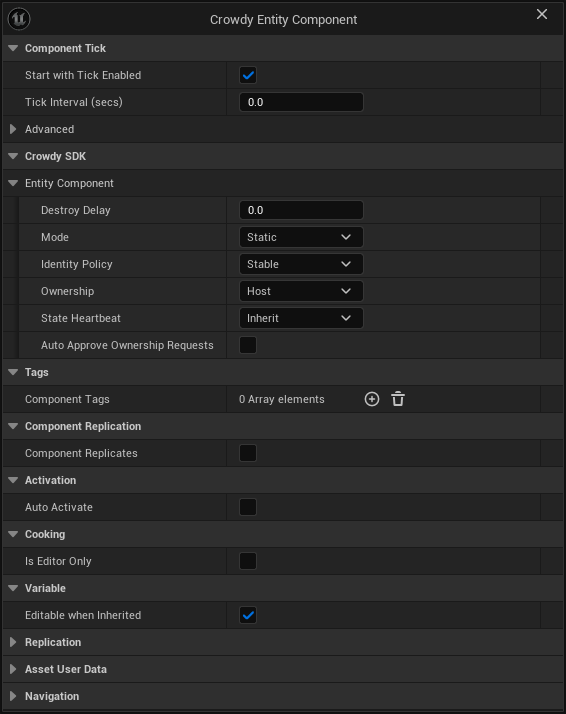
Settings
All EditAnywhere, so a constructor, a Blueprint's Class Defaults, or a placed instance can set them.
| Setting | Default | One line |
|---|---|---|
Mode (ECrowdyEntityMode) | Static | Static is event-only. Dynamic also streams the StateExecutor snapshot every replication interval. Unrelated to ownership and to Crowdy State, which work in either mode. |
IdentityPolicy (ECrowdyIdentityPolicy) | Stable | Stable, PlayerDerived, or Random. Read only when the actor resolves its own identity; a runtime spawn ignores it. |
Ownership (ECrowdyOwnership) | Host | Host: the elected host owns it (Role = HostOwned). LocalClient: this client owns it (Role = Owner). Level-placed actors only. |
HostOverride (ECrowdyHostOverride) | Allow | For a LocalClient entity: may the host correct its Crowdy State as a super-user (Allow), or never (OwnerOnly). Hidden when Ownership is Host. |
StateHeartbeat (ECrowdyStateHeartbeat) | Inherit | Inherit follows the map profile's keyframe; Off never emits a keyframe for this entity. On-change replication is unaffected. |
bAutoApproveOwnershipRequests | off | The current authority grants any transfer request at once instead of raising OnOwnershipRequested. |
StateExecutor (UActorUpdateExecutor) | none | Dynamic only. Builds the snapshot; unset means the SDK's transform-only default. |
bAutoRegister | on | Dynamic only. Join the continuous channel at BeginPlay; off means you call StartReplication yourself. |
DestroyDelay (float) | 0 | Seconds between OnCrowdyDestroyed and the actor being destroyed. |
Callables
Category Crowdy SDK, Entity Component in the Blueprint palette.
| Function | One line |
|---|---|
GetNetID() | The entity's shared id, as an FGuid. |
GetOwnerID() | The owning player's id; invalid for a host-owned entity. |
GetRole() | ECrowdyRole: Owner, RemoteProxy, HostOwned, or None before registration. |
IsLocallyOwned() | True when this client is the authority: it owns the entity, or the entity is host-owned and this client is the host. The question to ask before owner work. |
GetMode(), GetOwnership(), GetHostOverridePolicy(), GetStateHeartbeat() | The settings above, read back. There is no getter for IdentityPolicy. |
StartReplication(), StopReplication() | Join or leave the continuous channel. Meaningful for a Dynamic entity this client owns; bAutoRegister calls the first one for you. |
SendEvent(Payload, Scope) | Sends a struct payload addressed at this entity. ECrowdyEventScope::Everyone runs the entity's handlers on every client, OwnerOnly only on the owner. The lower-level sibling of a CrowdyEvent; see Recipients and routing. |
MarkStateDirty(PropertyName), MarkAllStateDirty() | Schedule one, or every, CrowdyManualDirty property to ship on the next replication tick. See Crowdy State: marking state from outside the actor. |
DestroyEntity() | Broadcast the destroy event and destroy the owner after DestroyDelay. The same path as the subsystem's DestroyEntity(Actor) and UCrowdyUtilities::DestroyCrowdyEntity. |
IsLocallyOwned() here takes no argument and answers for the authority; UCrowdyEntitySubsystem::IsLocallyOwned(NetID) answers a narrower question about the record's owner id and does not count the host of a host-owned entity. Do not treat them as interchangeable.
Events
| Event | Signature | When |
|---|---|---|
OnCrowdySpawned (FOnCrowdyEntitySpawned) | InitialState, bIsLocallyOwned | Runtime-spawned entities only: fired by SpawnEntity on the spawner and by the spawn event on every proxy, with the spawn payload. A level-placed entity never receives it; bind OnCrowdyOwnershipAssigned there instead. |
OnCrowdyDestroyed (FOnCrowdyEntityDestroyed) | bIsLocallyOwned | On every client when the entity is torn down, before the delay. |
OnCrowdyOwnershipAssigned (FOnCrowdyOwnershipAssigned) | NewOwnerID, NewRole, bIsLocallyOwned | Once the entity knows its owner, on the tick after registration (so a bind in BeginPlay still gets it), and again on every reassignment. NewOwnerID is invalid for a host-owned entity. |
The example binds all three in ALantern::BeginPlay, after Super::BeginPlay(); the three AddDynamic lines in the block go there. A lantern the player drops at runtime is the kind of entity that receives all three: the spawn path announces OnCrowdySpawned right after BeginPlay, on the owner and on every proxy, so a bind made there is in place in time. A level-placed post never gets the spawn event; on it only the destroy and ownership handlers ever run. The light shows on spawn, hides on destroy, and brightens or dims as the answer to "do I own this" arrives.
- C++
- Blueprint
// Lantern.h
UFUNCTION()
void HandleSpawned(const FInstancedStruct& InitialState, bool bIsLocallyOwned);

UFUNCTION()
void HandleDestroyed(bool bIsLocallyOwned);

UFUNCTION()
void HandleOwnershipAssigned(const FGuid& NewOwnerID, ECrowdyRole NewRole, bool bIsLocallyOwned);

// Lantern.cpp
CrowdyEntity->OnCrowdySpawned.AddDynamic(this, &ALantern::HandleSpawned);
CrowdyEntity->OnCrowdyDestroyed.AddDynamic(this, &ALantern::HandleDestroyed);
CrowdyEntity->OnCrowdyOwnershipAssigned.AddDynamic(this, &ALantern::HandleOwnershipAssigned);

void ALantern::HandleSpawned(const FInstancedStruct& InitialState, bool bIsLocallyOwned)
{
	// Spawned entities only: the spawn path announces it right after BeginPlay, on the owner and on every proxy.
	Light->SetVisibility(true);
}

void ALantern::HandleDestroyed(bool bIsLocallyOwned)
{
	Light->SetVisibility(false);
}

void ALantern::HandleOwnershipAssigned(const FGuid& NewOwnerID, ECrowdyRole NewRole, bool bIsLocallyOwned)
{
	Light->SetIntensity(bIsLocallyOwned ? 8000.f : 2000.f);
}
In the spawned lantern's Blueprint, at Event BeginPlay, Get Crowdy Entity Component feeds Bind Event to On Crowdy Spawned, whose Event pin is wired to a custom event, OnLanternSpawned, that receives the spawn payload and the ownership flag; its body calls Set Visibility on Light. The other two events bind the same way from the same getter.
Asking a different question than IsLocallyOwned
The Quickstart and the identity page both branch on IsLocallyOwned(). The accessor family answers finer questions: GetRole() distinguishes the owner from the host of a host-owned entity from a proxy, which the boolean cannot. The example grades the post's light by role.
Four more UCrowdyUtilities nodes ask role questions without fetching the component: CrowdyIsRemoteProxy(Entity) (Crowdy Is Remote Proxy) is true when the entity's role is RemoteProxy, and IsCrowdyEntityPlayerControlled(TargetActor) (Is Crowdy Entity Player Controlled) is true for an actor with a Dynamic entity component or a registered remote-proxy record; SwitchCrowdyIsRemoteProxy and SwitchIsCrowdyEntityPlayerControlled are the same two answers as exec pins.
- C++
- Blueprint
// LanternPost.h
void ShowRole();

// LanternPost.cpp
void ALanternPost::ShowRole()
{
	// The same client can own, host, or only mirror this post; each reads a different brightness.
	switch (CrowdyEntity->GetRole())
	{
	case ECrowdyRole::Owner:     Light->SetIntensity(8000.f); break;
	case ECrowdyRole::HostOwned: Light->SetIntensity(4000.f); break;
	default:                     Light->SetIntensity(1000.f); break;
	}
}
The generated graphs branch on booleans, so the three-way role grading of the C++ half is shown as its two-way half: Get Crowdy Entity Component, Is Locally Owned, a Branch, and Set Intensity to 8000 on Light for the owner. For the full grading in Blueprint, replace the Branch with a Switch on ECrowdyRole fed by Get Role.
The two RPC receivers on the component
RequestOwnership_Implementation(RequesterID) and GrantOwnership_Implementation(NewOwnerID, PreviousOwnerID) are CrowdyEvent functions with CrowdyRecipient = "Multicast" that carry ownership transfer over the session channel. Call the static UCrowdyOwnershipTransfer nodes instead of these; GrantOwnershipTo(NewOwnerID) is the C++ entry the static nodes funnel through.
They ride the app's session channel, which the SDK always joins, so a request or a grant reaches every client. Re-declared on a channel of their own they would reach that channel's members instead of the entity's audience. Ownership on this plane is a convention in any case; the enforced kind lives in your server code, on the truth plane.
Advanced: the static identity helpers
C++ only, pure, and the same functions the SDK's own identity resolution calls. Useful when writing custom identity code; not needed otherwise.
| Static | What it answers |
|---|---|
DeriveAuthority(Ownership, LocalPlayerID, OutRole, OutOwnerID) | The role and owner id an Ownership value produces. |
ResolveEffectiveOwnership(AuthoredOwnership, bIsLevelPlaced) | Why a runtime spawn is always owned by its spawner. |
ResolveActorInstanceGuid(Actor) | The engine's per-placement guid, the Stable identity seed. |
ShouldUsePlacementGuid(bIsLevelPlaced, bHasInstanceGuid), SelectPlacementGuid(AtRegister, Live) | When that guid may be used, and why the snapshot taken at OnRegister wins over a live read in a cooked build. |
ComputeStableNetID(bOutUsedPathFallback) | The Stable NetID for this actor, and whether it fell back to hashing the path. |
DoesOwnershipMatch(OwnerRole, OwnerNetID, TargetRole, TargetOwnerID, HostID) | The ownership test behind UCrowdyUtilities::DoesCrowdyEntityOwn; fails closed when a host-owned side has no host id. |
ClassifyPlayerDerivedIdentity(Facts), DescribePlayerDerivedIdentity(Verdict) | Which condition made PlayerDerived fall back to Random, and the sentence the warning uses. |
ShouldReportHostOwnedAutoRegister(Mode, bAutoRegister, Role), DescribeHostElectionState(bHostKnown, bLocalClientIsHost) | The two authoring diagnostics: a Dynamic host-owned entity ends BeginPlay sending nothing, and what this client currently knows about the host. |
GetClassID() | The class hash carried on spawn events. |
InitIdentity, AssignPooledIdentity, ClearIdentity, MarkPooledDormant, and IsPooledDormant are the injection points the entity subsystem and the actor pool use; game code has no reason to call them.
Gotchas
OnCrowdyOwnershipAssignedis announced on the tick after registration, deliberately, so a bind in the actor's ownBeginPlayis not too late.- A Dynamic entity with
Ownership = HostandbAutoRegisteron leavesBeginPlaysending nothing: auto-register only starts the channel for an entity this client owns outright. The log says so once per component. DestroyEntity()exists in three places with three signatures and one behaviour. Use whichever you already hold a reference for.- The enum getters return the setting, not a live derivation.
GetRole()is the live answer.
Related
- Entities, Identity, and Ownership: what the settings mean.
- Entities and spawning: the subsystem's spawn, destroy, and lookup calls.
- Ownership transfer: the static nodes that replace calling the two receivers.
- Crowdy State: the properties
MarkStateDirtyserves. - Continuous state:
Mode,StateExecutor, andbAutoRegister.