Map Profile
A map profile is required setup. Every playable map needs a UCrowdyMapProfile assigned to it.
This page covers what a map profile is, the fields it carries, and how to create and assign one.
Without a profile, the SDK is inactive on that map. The entity subsystem, the auto replicator, and the actor manager all silently do nothing. Replication looks dead even though your code is correct.
What a map profile is
UCrowdyMapProfile is a UDataAsset. It tells the SDK whether to run on a map and how to manage actors there.
The SDK resolves the profile for the current world through UCrowdySDKDeveloperSettings::ResolveProfileForWorld. If no profile resolves, the SDK stays inactive and logs a warning.
Top-level fields
| Field | Type | Purpose |
|---|---|---|
bEnableNetworking | bool | Gates the SDK on the map. When false, the SDK does not run here. |
ActorManagement | FCrowdyActorManagementConfigStruct | Backend selection and actor tracking settings. |
bUseAutoReplicator | bool | Enables the auto replicator, which polls Dynamic entity state and sends it. |
ReplicationIntervalHz | int | Replication rate in hertz. Range 1 to 10, default 10. Shared cadence for both the auto replicator and the Crowdy State replicator. |
bUseStateReplicator | bool | Default true. Master switch for the Crowdy State per-property replicator on this map. When false, Crowdy State does not run here. |
StateRelevanceDistance | ECrowdyReplicationDistance | Spatial relevance radius for Crowdy State deltas, tighter than the continuous channel. Default Four_Chunks. |
StateKeyframeIntervalSeconds | float | How often, in seconds, CrowdyHeartbeat-marked properties are re-sent as a keyframe baseline. Default 2.0. Set it to 0 or below to disable the keyframe heartbeat map-wide. |
ActorManagement fields
ActorManagement is an FCrowdyActorManagementConfigStruct. It carries the actor tracking and rendering backend settings.
| Field | Type | Notes |
|---|---|---|
bUseCrowdyActorTracker | bool | Use the Crowdy actor tracker. |
bDispatchUpdatesOnGameThread | bool | Dispatch state updates on the game thread. |
bEnableOwnerTracking | bool | Default true. Echo the owner's own state back as a network proxy. |
ActorTimeoutThreshold | float | Time before an untracked actor is considered gone. |
MaxTrackedActors | int | Cap on tracked actors. |
MaxUpdatesPerBatch | int | Cap on updates processed per batch. |
MaxBatchWaitTime | float | Maximum time to wait while filling a batch. |
BackendClass | TSubclassOf<UCrowdyRenderingBackend> | The rendering backend. Defaults to UCrowdyActorPoolBackend. |
BackendConfig | instanced UCrowdyRenderingBackendConfig | Settings for the selected backend. |
The Actor Pool backend uses UCrowdyActorPoolBackendConfig for its BackendConfig. That config exposes:
ReplicationPolicyClassPoolPolicyClassDefaultPoolSizePerClass(default 8)PerClassPoolOverrides
To select a different backend, see Rendering Backends.
Crowdy State replication
Crowdy State is the fast, client-authoritative view plane for per-property replication. The map profile controls whether it runs and how often it re-baselines.
bUseStateReplicatorgates the whole plane on the map. Leave it true for maps that use replicated variables.StateRelevanceDistancesets how far a Crowdy State delta travels from the sender, the same chunk-based scale asECrowdyReplicationDistance.StateKeyframeIntervalSecondsis a safety net, not the mechanism. On-change replication ships a changed property every tick regardless of this value. The keyframe heartbeat only re-sendsCrowdyHeartbeat-marked properties periodically so a late or desynced observer converges. Set it to 0 (or any value at or below 0) to turn the heartbeat off map-wide; edits still replicate on change.
Per entity, UCrowdyEntityComponent can further set StateHeartbeat to Off to suppress the heartbeat for one entity. See Crowdy State for the full plane, and the state metadata keys reference for CrowdyHeartbeat and the other per-property keys.
Authoring a replicated Blueprint variable
You do not need C++ to put a variable on the Crowdy State plane. Select a variable in an Actor or Actor Component Blueprint and use the "Crowdy Replication" dropdown in its Details panel:
- Choose
Replicatedto replicate the variable on the Crowdy State plane.Noneremoves it. A future server-authoritative mode is reserved but not selectable yet. - Picking
Replicatedauto-creates anOnRep_<Variable>RepNotify function you can fill in. - A
Heartbeattoggle defaults on when you first enterReplicated, opting the variable into the keyframe heartbeat described above. - Advanced sub-options cover owner-only delivery and manual-dirty scheduling.
- An unsupported variable type fails the Blueprint compile with a clear message rather than silently not replicating.
- Get and Set nodes for a replicated variable show the same replication badge Unreal draws on natively replicated variables.
The mode you pick maps to ECrowdyReplicationMode. For the full authoring walkthrough, see Crowdy State.
Create the asset
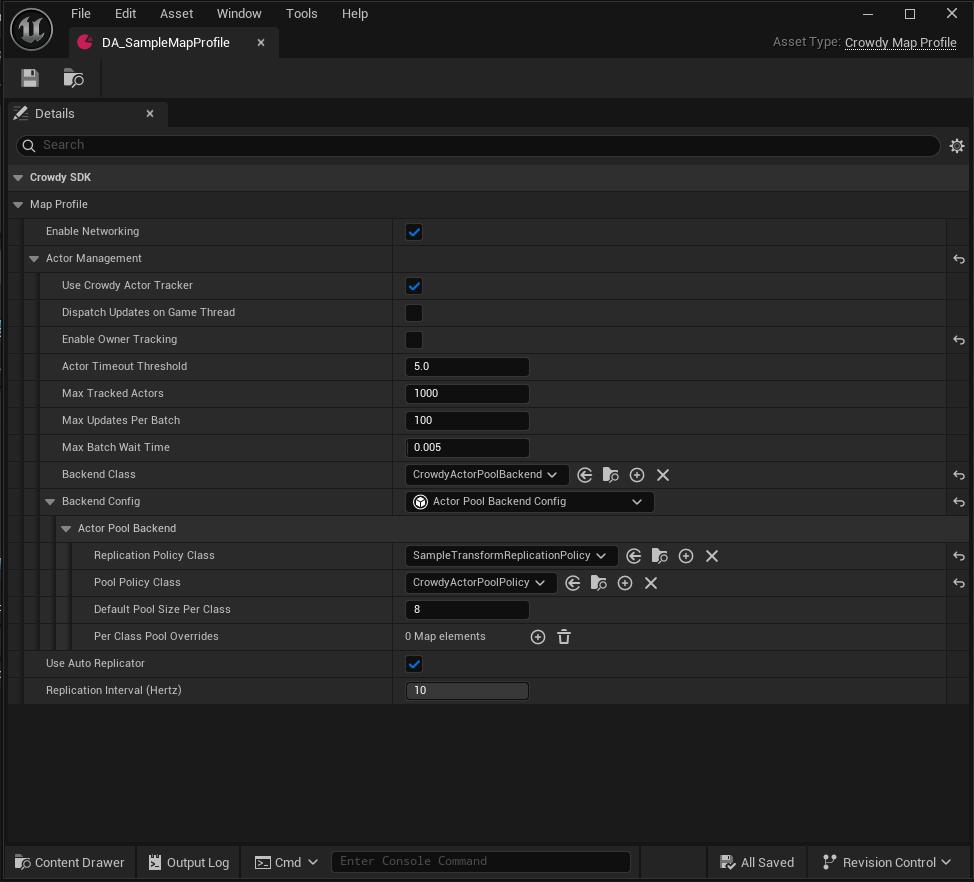
Create a data asset, pick the profile class, then set its fields.
- In the Content Browser, right-click and choose Miscellaneous, then Data Asset.
- Pick
CrowdyMapProfileas the asset class. - Name it, for example
MP_DefaultMapProfile. - Open it and set the fields. For a standard setup, enable
bEnableNetworking, leaveActorManagement.BackendClassat the Actor Pool default, and enablebUseAutoReplicator.
Assign the profile
Profiles are assigned in project settings, not on the map asset itself.
- Open Edit, Project Settings.
- Go to Plugins, Crowdy SDK, Map Profiles.
- Set one of:
DefaultProfile: used for any map that is not listed inMapProfiles.MapProfiles: a per-map map. Add an entry that points a specific map to a specific profile.
When to use which:
- Use
MapProfileswhen different maps need different backends or replication settings. - Use
DefaultProfileas a fallback so unlisted maps still have the SDK active.
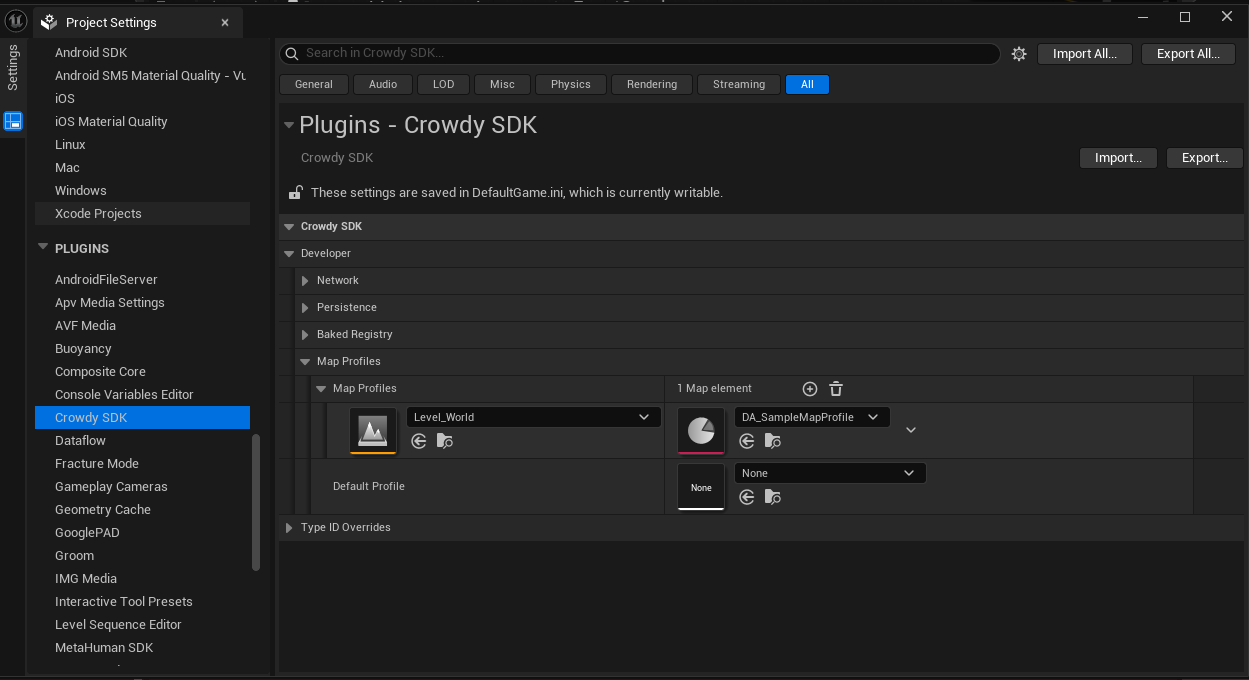
The settings section in the config file is [/Script/CrowdyReplication.CrowdySDKDeveloperSettings]. See Project Settings for the full settings reference.
With no profile resolved for a map, the entity subsystem, auto replicator, and actor manager do nothing. You get a warning in the log, but no error, so replication looks dead.
If entities are not replicating on a map, check that the map has a profile through DefaultProfile or MapProfiles first.
Minimal working profile
For most maps, this is enough:
bEnableNetworking: trueActorManagement.BackendClass:UCrowdyActorPoolBackend(the default)bUseAutoReplicator: trueReplicationIntervalHz: 10
Assign that asset as DefaultProfile and the SDK is active on every map that does not have its own entry.