Rendering Backends
A rendering backend decides how a replicated entity appears on remote clients.
When the owner of an entity sends state, every other client holds a remote proxy. The backend turns that incoming state into something on screen. It:
- Activates a visual when an entity comes into range.
- Deactivates it when the entity leaves.
- Applies interpolated state each frame.
The backend is pluggable through the UCrowdyRenderingBackend interface. The class is abstract, Blueprintable, and EditInlineNew.
The default backend
The shipped default is UCrowdyActorPoolBackend. It spawns and pools real actors for each entity class.
Most projects never change it. If you do nothing, the map profile resolves to this backend with UCrowdyActorPoolBackendConfig.
You only need a custom backend when actor pooling is the wrong model for your project. A Mass Entity based backend is also under works, and will be available in a future release.
The backend is selected per map through the map profile. See Map Profiles for how a profile is resolved for a world.
Writing a custom backend
Subclass UCrowdyRenderingBackend and implement the four required overrides. The two lifecycle overrides are optional.
Required overrides
These are pure virtual. You must implement all four.
ActivateInstance(int32 SlotId, const FGuid& UUID, UClass* EntityClass, const FInstancedStruct& InitialState): create or claim a visual for this entity. The actor manager calls this when an entity becomes visible.DeactivateInstance(int32 SlotId, const FGuid& UUID): release the visual for this entity. Called when the entity leaves range or is destroyed.ExtractUpdate(const FInstancedStruct& State, int64 ServerTimestampMs, int32 SlotId): take an incoming state snapshot and store it against the slot, keyed by the server timestamp, so it can be interpolated.ApplyInterpolation(int32 SlotId, int64 RenderTimeMs): drive the visual to the interpolated state for the given render time. Called each frame.
Optional overrides
InitializeBackend(UWorld* World, UCrowdyRenderingBackendConfig* Config): one-time setup when the backend starts. Read your config here.DeinitializeBackend(): tear down anything you allocated inInitializeBackend.
Skeleton
UCLASS(EditInlineNew)
class UMyRenderingBackend : public UCrowdyRenderingBackend
{
    GENERATED_BODY()

public:
    virtual void InitializeBackend(UWorld* World, UCrowdyRenderingBackendConfig* Config) override;
    virtual void DeinitializeBackend() override;

    virtual void ActivateInstance(int32 SlotId, const FGuid& UUID, UClass* EntityClass, const FInstancedStruct& InitialState) override;
    virtual void DeactivateInstance(int32 SlotId, const FGuid& UUID) override;
    virtual void ExtractUpdate(const FInstancedStruct& State, int64 ServerTimestampMs, int32 SlotId) override;
    virtual void ApplyInterpolation(int32 SlotId, int64 RenderTimeMs) override;
};
Pairing a config class
A custom backend carries its own settings in a UCrowdyRenderingBackendConfig subclass. Define one config class alongside your backend, then read it in InitializeBackend.
UCLASS(EditInlineNew)
class UMyRenderingBackendConfig : public UCrowdyRenderingBackendConfig
{
    GENERATED_BODY()

public:
    UPROPERTY(EditAnywhere)
    int32 MaxVisibleInstances = 256;
};
The Actor Pool backend follows the same pattern. Its config is UCrowdyActorPoolBackendConfig, with fields such as DefaultPoolSizePerClass (default 8) and PerClassPoolOverrides.
Selecting the backend in the map profile
The backend is chosen in the map profile, inside ActorManagement (a FCrowdyActorManagementConfigStruct). Two fields control it:
BackendClass: aTSubclassOf<UCrowdyRenderingBackend>. Defaults toUCrowdyActorPoolBackend. Set this to your backend class.BackendConfig: an instancedUCrowdyRenderingBackendConfig. Set this to an instance of your config class.
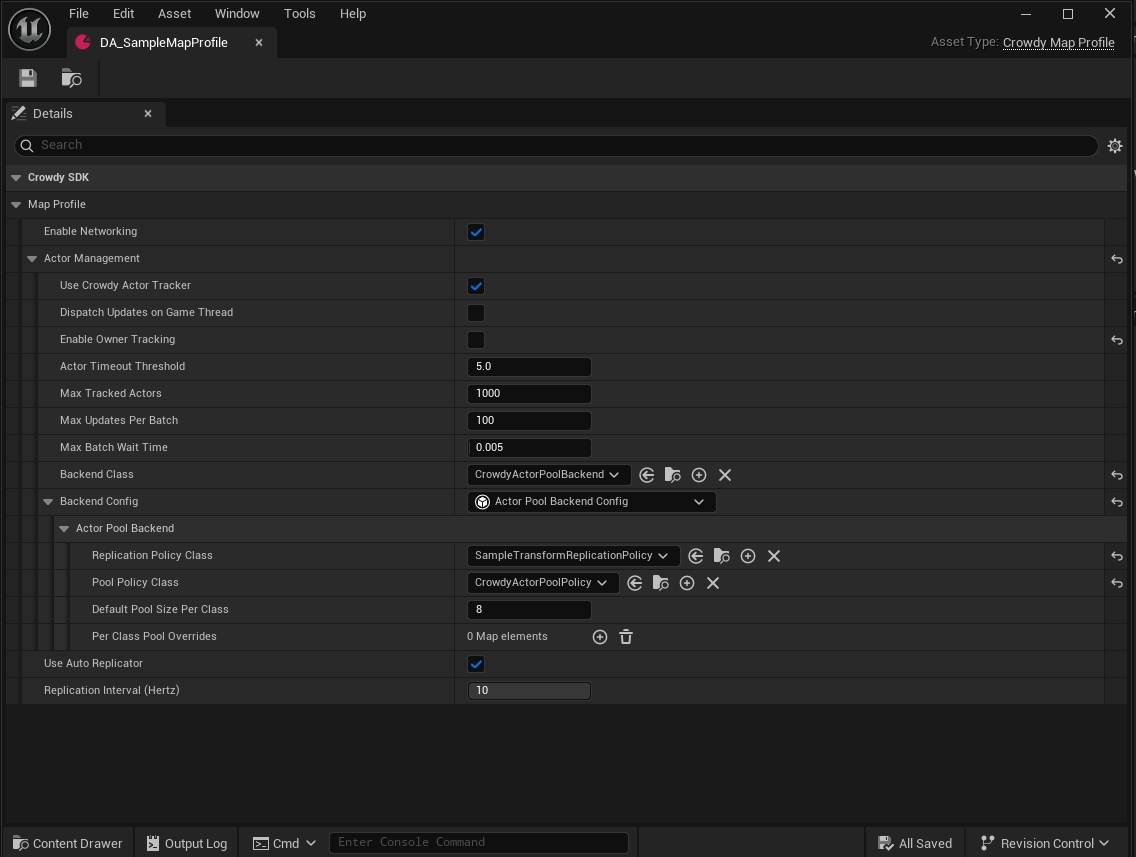
Assign the profile to your map in Project Settings, Plugins, Crowdy SDK, Map Profiles. See Map Profiles for the full setup.
Do not re-subscribe to the ActorTracker
The actor manager already drives your backend. It calls ActivateInstance and DeactivateInstance for you as entities come and go.
A custom backend must never subscribe to the ActorTracker itself. The actor manager is already the single caller of ActivateInstance and DeactivateInstance. If your backend also subscribes, every entity is activated twice and you get a double spawn.
Treat the four required overrides as your only entry points for activation and update. Do not reach into the tracker to find entities on your own.